
Research
Research Areas: Agentic AI/Small Language Models, Information Systems Trust, Escrows, Prediction Markets, Digital Assets/Distributed Ledgers
Papers
Large Language Models
- Working Paper Information or Institution? AI’s role in Expert Testimony
- Coauthors: Shou-Ming Chang [show abstract]
This paper studies whether the value of expert testimony lies primarily in its informational content or in the institutional role of the expert witness. Using federal district court Daubert rulings in copyright cases, we show that admissibility is not determined by methodology alone, but also by institutional considerations. We develop a model to ground this intuition and to show how AI can compress differences in methodological production while making institutional signals more important for judicial evaluation. Empirically, we then compare observed expert packages to AI-generated packages from neutralized case descriptions and find that AI reproduces much of the methodology and topic coverage of retained experts, while systematically proposing broader and more credentialed expert designs. AI-generated packages are closest to experts whose testimony is admitted and furthest from those whose testimony is excluded. The results show that methodology is increasingly reproducible, but institutional features of the expert still matter for admissibility.
Conferences and Presentations
- The First Workshop on Sovereign AI for Collaborative and Pluralistic AI Ecosystems, HCOMP 2026, Washington, D.C., September 2026; Information or Institution? AI's role in Expert Testimony (with Shou-Ming Chang)
Digital Assets
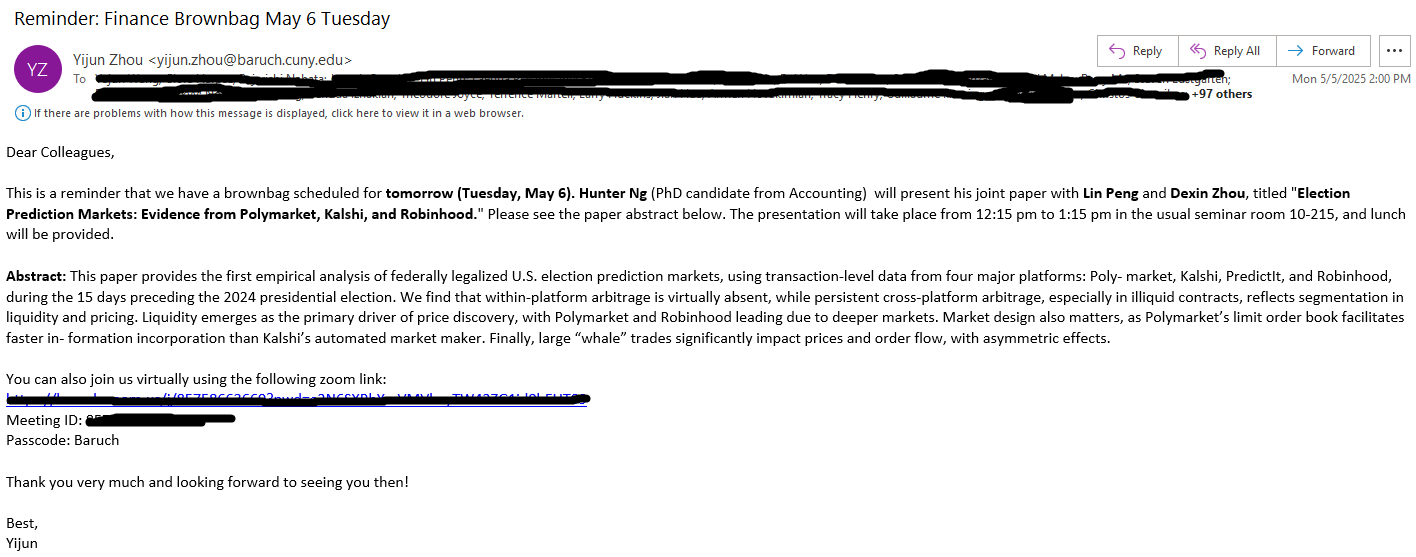
- Working Paper Election Prediction Markets: Evidence from Polymarket, Kalshi, and Robinhood
- Coauthors: Lin Peng, Dexin Zhou, Yubo Tao [show abstract]
This paper provides the first empirical analysis of federally legalized U.S. election prediction markets, using transaction-level data from four major platforms: Polymarket, Kalshi, PredictIt, and Robinhood, during the 15 days preceding the 2024 presidential election. We find that within-platform arbitrage is virtually absent, while persistent cross-platform arbitrage, especially in illiquid contracts, reflects segmentation in liquidity and pricing. Liquidity emerges as the primary driver of price discovery, with Polymarket and Robinhood leading due to deeper markets. Market design also matters, as Polymarket’s limit order book facilitates faster information incorporation than Kalshi’s automated market maker. Finally, large “whale” trades significantly impact prices and order flow, with asymmetric effects.
Conferences and Presentations
- 3rd Financial Fraud, Misconduct and Market Manipulation Conference 2026 - Travel & Accommodation - Download Agenda - Download PPTX
- Finance Seminar, Baruch College, June 2025
- Finance Seminar, The Hong Kong Polytechnic University, October 2025
- Working Paper How Wash Traders Exploit Market Conditions in Cryptocurrency Markets [show abstract]
Wash trading, the practice of simultaneously placing buy and sell orders for the same asset to inflate trading volume, has been prevalent in cryptocurrency markets. This paper investigates whether wash traders in Bitcoin act deliberately to exploit market conditions and identifies the characteristics of such manipulative behavior. Using a unique dataset of 18 million transactions from Mt. Gox, once the largest Bitcoin exchange, I find that wash trading intensifies when legitimate trading volume is low and diminishes when it is high, indicating strategic timing to maximize impact in less liquid markets. The activity also exhibits spillover effects across platforms and decreases when trading volumes in other asset classes like stocks or gold rise, suggesting sensitivity to broader market dynamics. Additionally, wash traders exploit periods of heightened media attention and online rumors to amplify their influence, causing rapid but short-lived spikes in legitimate trading volume. Using an exogenous demand shock associated with illicit online marketplaces, I find that wash trading responds to contemporaneous events affecting Bitcoin demand. These results advance the understanding of manipulative practices in digital currency markets and have significant implications for regulators aiming to detect and prevent wash trading.
Conferences and Presentations
- The Annual Baruch College/CUNY Southwestern University of Finance and Economics (SWUFE) Research Symposium, Baruch College, May 2025
Accounting Information Systems
- Working PaperIRB Approved Using a Sandboxed Ticketing Bot to Teach Digital Trust and IT Audit
- Coauthors: Lorraine Lee, Hagit Levy-Shalev, Shantel Deleon (EY LLC) [show abstract]
The verification of Information Technology (IT) controls is a core responsibility of IT auditors. This case places students in the role of IT auditors assigned to assess the effectiveness of controls over a sandboxed online ticketing system. Students first participate in limited ticket drops, inspect the website’s Document Object Model (DOM), and use AI-assisted coding to understand how automated purchasing can occur. Students then evaluate whether the system’s controls over purchase limits, transaction authorization, backend logging, exception reporting, and monitoring are effective. The case introduces students to technical skills such as browser inspection, basic automation logic, and AI-assisted coding while maintaining an internal-control focus. Students document their work through a DOM discovery worksheet, ticket-drop observation sheet, internal-control review matrix, and short reflection. The case is relevant to Accounting Information Systems (AIS), IT Audit, and Audit courses because it connects digital trust, automated transactions, IT controls, and AI-assisted technical fluency. Instructors may use the case at either the undergraduate or graduate level.
- Working PaperIRB Approved Scalable Data Analytics Pedagogy in Accounting: Randomized Case Studies and Automated Assessment
- Coauthors: Hagit Levy-Shalev, Carol Marquardt [show abstract]
The growing importance of data analytics (DA) in accounting has changed how accounting professionals collect, analyze, and interpret data. As DA becomes increasingly integrated into accounting practice, accounting students need assignments that combine analytical, technical, and professional judgment skills. This paper presents a scalable teaching case that uses randomized datasets and automated grading to support individualized student analysis in larger classes. Each student receives a unique dataset generated from a common underlying structure, preserving consistent learning objectives while reducing the usefulness of shared solutions. In the case, students estimate the allowance for doubtful accounts using historical customer-level accounts receivable data and compare the percentage-of-sales method with the aging-of-receivables method. Students complete spreadsheet-based analysis and prepare a written recommendation supported by their results. Automated grading evaluates the technical outputs, while the written report assesses interpretation and communication. The case provides a flexible model for integrating DA competencies into accounting courses without requiring extensive programming expertise from instructors.
Econometrics
- Working Paper Vine Copula VAR [show abstract]
This paper introduces a scalable and order-invariant framework for modeling high-dimensional macro-financial dynamics. We develop a Time-Varying Parameter VAR with Vine Copula Dependence (VCVAR), which couples a lightweight TVP backbone with a flexible copula representation of cross-sectional dependence. The approach separates marginal dynamics from joint dependence, allowing the model to capture structural drift together with asymmetric, nonlinear, and tail-dependent co-movements that standard Gaussian or Cholesky-based VARs cannot represent. Despite this flexibility, the VCVAR remains computationally tractable through discounted recursive estimation and simplified vine construction. Applications to empirical macroeconomic data and controlled simulation designs show that the VCVAR offers consistent improvements in medium- and long-horizon forecasting, demonstrating the value of combining time variation with non-Gaussian dependence in large systems.
General Economics, Sociology, Anthropology
- Published Legitimacy and the Fluid Singaporean Welfare State (Sociology Compass) [show abstract]
This paper develops a theory of the fluid welfare state, in which legitimacy rather than efficiency constitutes the central constraint of welfare governance. Using a dynamic model of government–citizen interaction, we show that a state that adjusts its welfare messaging across social groups enhances legitimacy when the persuasive benefit exceeds the credibility cost. The framework is inductively derived from the case of Singapore, which exemplifies how a small, open, and fiscally disciplined East Asian productivist welfare state can sustain public trust through performance and communication rather than extensive redistribution. As welfare communication increasingly takes place through digital platforms and social media, the capacity to adapt these narratives can be a powerful tool for all regimes. The concept of the fluid welfare state therefore provides a framework for understanding how contemporary governments, particularly those facing fiscal and demographic constraints, can preserve welfare legitimacy through adaptive persuasion rather than expansionary spending.
- Working Paper Secularization of Curses by LLM Guardrails [show abstract]
This article studies how AI guardrails classify curse-talk, meaning the language through which ritual harm is requested, described, translated, fictionalized, feared, resisted, or explained. Curses are useful because they separate hostile intent from material mechanism. A curse is not a bomb or a poison, but a request to curse someone may still express revenge, coercion, or harm. I argue that AI guardrails secularize curse-talk. They do not decide whether magic is real. They decide whether ritual language is acceptable speech, translating curses into platform categories such as harassment, coercion, coping, fiction, scholarship, or prohibited harm. Using a controlled prompt audit across five models, I find that guardrails do not treat curse-talk as a single unsafe category. Historical, cultural, translational, fictional, and enhancement-oriented prompts were usually allowed, while direct harm, justified revenge, and protection-through-harm prompts produced the strongest refusals. The results suggest that guardrails respond less to ritual vocabulary itself than to the inferred social function of the request.
- Working Paper Why is it so hard to find a job now? Enter Ghost Jobs
- Coauthors: Yen Tong [show abstract]
This paper investigates "ghost jobs", which are vacancies posted without intent to hire, using a novel dataset of interview reviews from Glassdoor. Using a fine-tuned BERT model, I find that approximately 21% of job postings exhibit patterns consistent with ghost jobs. These are disproportionately concentrated in larger firms and high-skill industries, where firms may benefit from resume collection, market intelligence, or signaling. I also show that incorporating ghost job prevalence helps reconcile the recent disconnect in the Beveridge Curve between vacancy and hiring rates. The results highlight how ghost hiring imposes costs on job seekers, distorts labor market indicators, and warrants closer scrutiny from policymakers.
Notes on Becoming a Researcher
- Reflective Essay True Seeker – An Accounting PhD Journey
- Reflective Essay History of Economic Thought: A Dialogue Format
Conferences and Presentations
- Presenter2026 Midwest Econometrics Group (MEG) Annual Meeting - Download Invitation - Download Information
- Presenter2026 The First Workshop on Sovereign AI for Collaborative and Pluralistic AI Ecosystems, HCOMP 2026, Washington, D.C., September 2026; Information or Institution? AI’s role in Expert Testimony (with Shou-Ming Chang)
- Presenter2026 3rd Financial Fraud, Misconduct and Market Manipulation Conference 2026 - Travel & Accommodation - Download Schedule - Download PPTX
- Participant2026 AAA Global Connect Annual Meeting - Download Participant List
- Participant2026 Baruch Workshop on AI in Finance and Accounting Download Agenda
- Participant2026 The 24th Annual Financial Reporting Conference Download Agenda
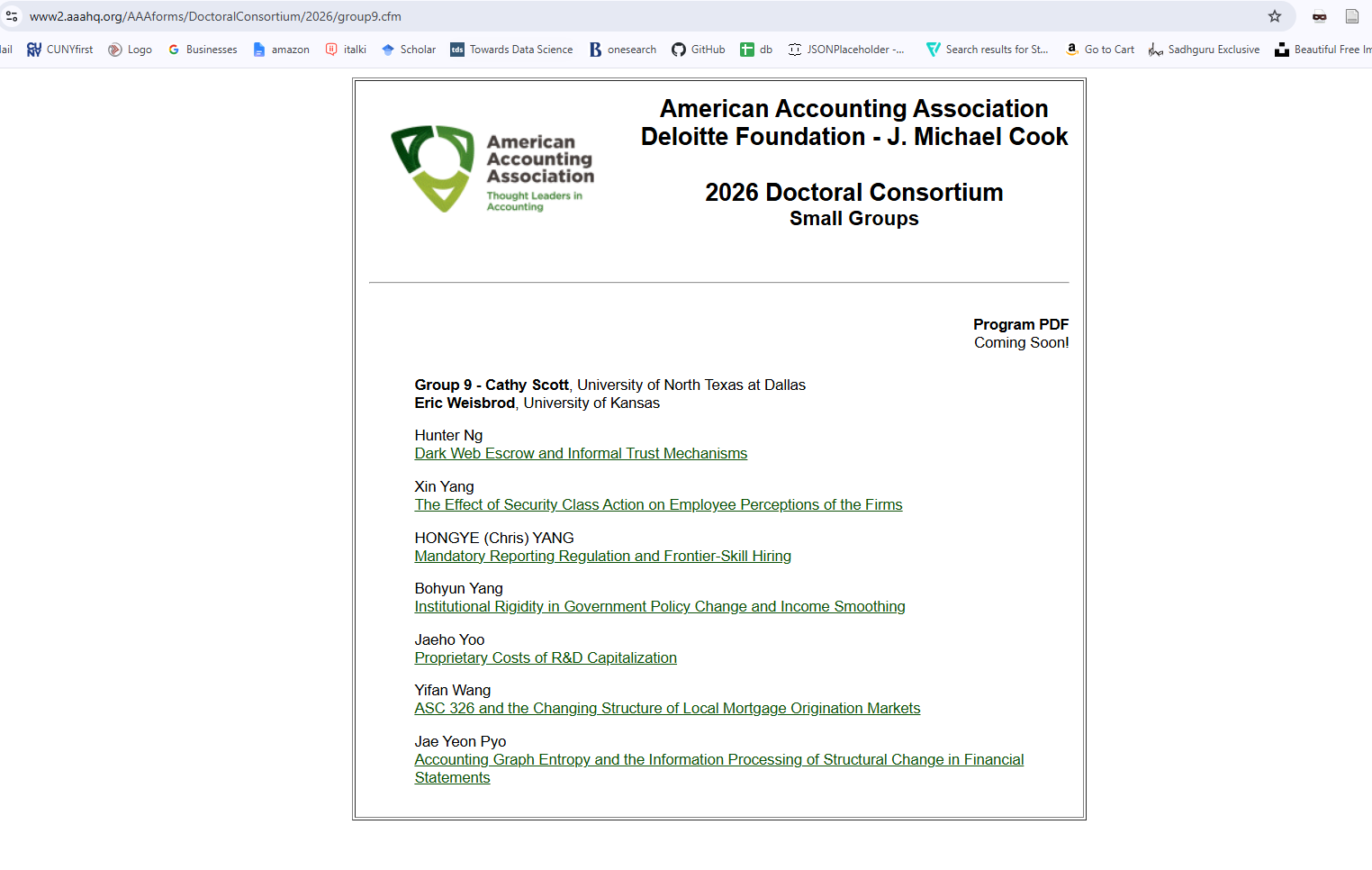
- Presenter2026 AAA/Deloitte/Michael Cook Doctoral Consortium Download Agenda
- Participant2026 Four-School Conference (Baruch, Fordham, Rutgers, UConn)
- Participant2025 AES Baruch Accounting Theory Summer School
- Taught by Ivan Marinovic, Jon Glover, Jeremy Bertomeu
- Presenter2025 Hawaii Doctoral Institute Summer
- Taught by Hans Christensen, Brian White, Joe Schroeder, Jennifer Blouin
- Gave presentations in class on selected papers - Download Certificate - Download Schroeder PPT - Download Blouin PPT - Download White PPT - Download Christensen PPT
- Presenter2025 Baruch-SWUFE Research Symposium
- Presenter2025 Baruch PhD Research Day in Finance
- Presenter2025 Finance Brownbag
- Participant2025 Baruch/JFQA Climate Finance Conference
- Participant2025 Baruch-Fordham-Rutgers Trischool Conference
- Participant2024 The Chinese Finance Association TCFA 30th Annual Conference
- Participant2024 NYU Accounting Theory Summer School
- Taught by Ilan Guttman, Judson Caskey, Jeremy Bertomeu
- Presenter2024 Duke University Accounting Theory Summer School
- Presented “Cybersecurity Disclosures”
- Taught by Itay Goldstein, Qi Chen, Chandra Kanodia, Thomas Hemmer
Dissertation Committee and Advisors
Dissertation Committee
- Edward Li (Baruch College)
- Lin Peng (Baruch College)
- Hagit Levy-Shalev (Baruch College)
- Michael Grossman (CUNY Graduate Center)
Advisors
- Yen Tong (Nanyang Technological University)
- Diana Weng (University of South Florida)
- Hun-Tong Tan (Nanyang Technological University)
Peer Reviews
- 2026 Reviewer for Cogent
- 2026 Reviewer for Journal of International Financial Markets, Institutions & Money
- 2025 Reviewer for Cogent
- 2025 Reviewer for Journal of International Financial Markets, Institutions & Money
- 2023 Management Science Reproducibility Project
Awards
- 2025/2026 Zicklin Dean’s Teaching Award
- Mills & Tannenbaum Award 2025
- Donald Vredenburgh Research Grant 2025