
As Coarse As Emporium
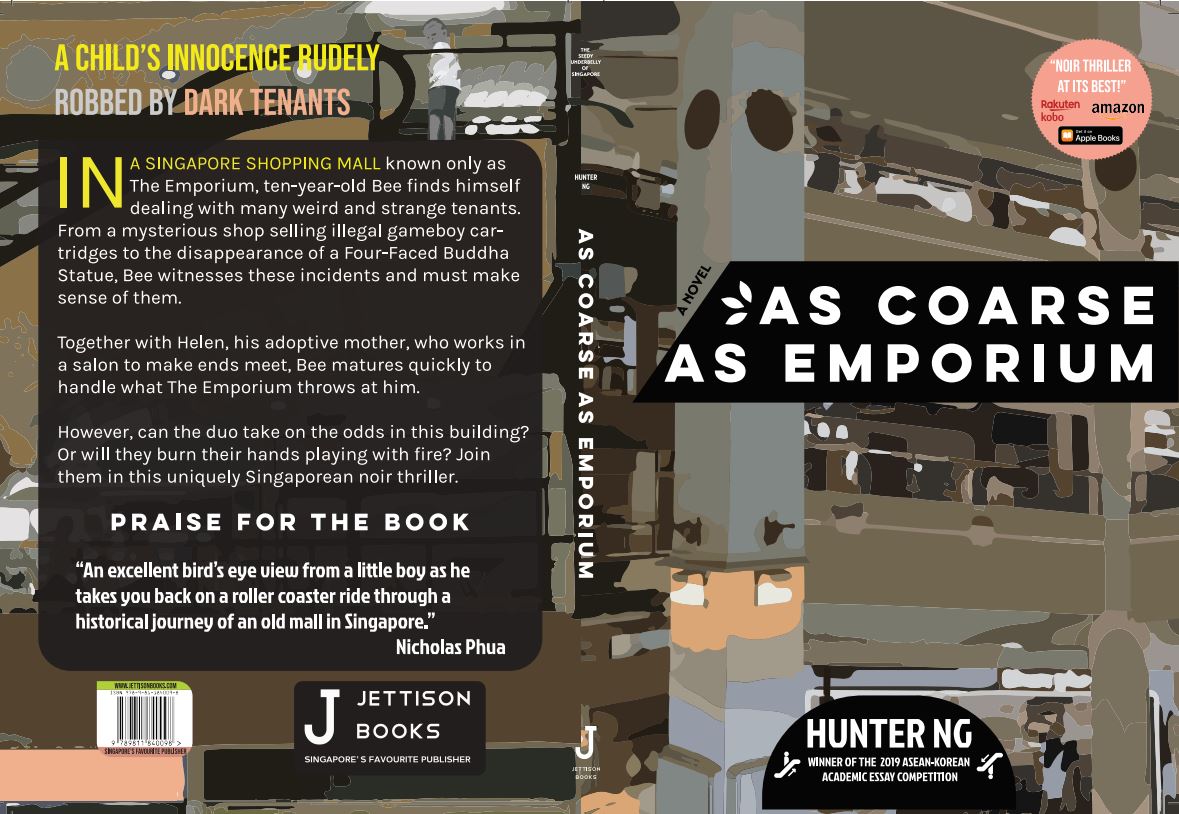
As Coarse As Emporium is a Singaporean noir thriller novel about ten-year-old Bee, who grows up inside a Singapore shopping mall known as The Emporium.
Summary
In a Singapore shopping mall known only as The Emporium, ten-year-old Bee finds himself dealing with many weird and strange tenants. From a mysterious shop selling illegal gameboy cartridges to the disappearance of a Four-Faced Buddha Statue, Bee witnesses these incidents and must make sense of them. Together with helen, his adoptive mother, who works in a salon to make ends meet, Bee matures quickly to handle what The Emporium throws at him. However, can the duo take on the odds in this building? Or will they burn their hands playing with fire? Join them in this uniquely Singaporean noir thriller.
Author’s Note
I wrote this novel during the Covid pandemic as I was about to begin my life overseas and feared losing the precious memories I had of Upper Serangoon Shopping Centre, which I had grown up in. I would remember running like a wild monkey up and down the escalators in the building, playing catching with the children of the other tenants. The memories are fading but poignant. I want to present these true memories in a way that would be easy for the reader and in a uniquely Singaporean manner. As such, I chose a thriller novel as the genre. About 95% of the incidents in the book are true and it would be like a glimpse into the past of the shopping centers in Singapore, in particular, Upper Serangoon Shopping Center. I didn’t do much publicizing of the book when I wrote it and self-published but I hope that the book continues to carry on these forgotten stories of what truly happened in old malls in Singapore. Thank you.
Featured Chapter: The Sauna
A sauna used to be a straightforward construction in the past. The oldest saunas were simple spaces heated to a high temperature by fireplaces. People went in, sweated, detoxed and had a refreshing shower thereafter. It was a sensual experience, but not sexual.
When I was ten years old, Helen, my adoptive mom earned a meagre income working for June, her mom, at her salon. Helen and I led a frugal life. In the daytime, nobody was home to care for me, so Helen brought me to the salon.
The salon was located in The Emporium, a commercial building in the heart of Singapore. When I was old enough, I took public transport to the salon after school. While she was busy with customers, our neighbours from other shops would take care of me. I became very good friends with most of them.
In this chapter, Bee reflects on how adult spaces are explained to children in sanitized terms, and how meaning changes once innocence collides with economic necessity and proximity to adult desire. The sauna becomes both a literal location and a metaphor—an enclosed, heated environment where boundaries blur and silence becomes complicit.
When I was ten years old, Helen, my adoptive mom earned a meagre income working for June, her mom, at her salon. Helen and I led a frugal life. In the daytime, nobody was home to care for me, so Helen brought me to the salon. The salon was located in The Emporium, a commercial building in the heart of Singapore. When I was old enough, I took public transport to the salon after school. While she was busy with customers, our neighbours from other shops would take care of me. I became very good friends with most of them.
The most notable or perhaps, also the most inconspicuous business in The Emporium was the “De Sauna”. From our salon, if you turned right and walked to the end, you would see it. The bright red neon light- board that screamed the words “De Sauna” was the only indication that it even existed. Most units in The Emporium maxed out at about 250 to 300 square feet but this behemoth business had combined eight smaller units and had hacked down their respective walls to create a large and uninterrupted space for their operations.
Our salon was located on the 3rd storey. The 3rd storey had two toilets and one toilet area was located just beside De Sauna. I always got a glimpse of De Sauna when I wanted to pee. Many strange men lurked outside De Sauna and so, I always did my business and quickly ran back to the salon. I did not want to find out what they were there for.
There was only one nondescript entrance for customers. Five vases of exquisite two-toned purple moth orchids sat on the counter-top. Other than this, there was another off-limits side entrance. It led to the girls’ private rooms, where they rested between breaks. On the few occasions that I had passed by to head to the toilet, the door was ajar and I peered in.
It was a dimly lit room, but I could make out the many beds and vanity tables strewn haphazardly in different corners. Many of the female masseurs took short naps when business was in a lull. Other than that, I only saw men going in and out of the nondescript main entrance, nothing more nor less.
Helen always had this love-hate relationship with the masseurs. On some days, she would lament to the salon customers that these wom- en spoilt relationships and seduced many men. However, behind their backs, she would always teach me that all the stupid men were also to be blamed. If a man had a wife, he should not give in to temptation. She also taught me that “prostitution” was the oldest trade in the world. Even till today, this trade has continued, and not vanished like other lost trades such as exquisite Hakka tailoring or the Kacang Puteh (mixed nuts packet) in Singapore. For a trade to have survived this long, and still continue to flourish, was plain evidence that there was strong business need for such services. And men’s’ physiological urges weren’t going to disappear anytime soon.
As a kid, I never really knew what business they were doing till much later. I also didn’t know why so many women were employed. On several occasions, I saw the girls running out of the unit into the toilet, wrapped only in white bath towels. However, I was more interested in playing my Gameboy and doing well in my studies. I didn’t once ask why they were scantily-clad nor what they did to the men who went in.
De Sauna was run by Mrs Kiyomi. She was a tall and imposing Chinese lady, and her hair was always impeccably combed into a high, elegant French Twist, held in place by an oriental long chopstick. She had a thick, translucent green jade bangle on her left wrist. Rumour was that she used to be the head of a secret society, and that she was a blackbelt in Aikido.
Mrs Kiyomi employed at least twenty “girls” under her. Helen knew most of these girls, as our salon was quite popular back then and most of them also came over for hair-dos.
The girls were often well-mannered and paid lip service to everyone. As a “masseur”, the last thing you wanted to do was to offend anybody. Singapore had strict laws on massage parlours and such services so if you were to offend certain people, it became immensely difficult to earn a living doing what they did.
One of the ways to judge how good their business was, was by count- ing the number of large orange gurney sacks of towels outside their unit. Mrs Kiyomi employed a full-time staff, a woman whose son, Mark was the same age as me. We never knew her real name so we would call her Mark’s Mom. Mark’s Mom was employed as a full-time cleaner cum attendant. Every morning, after my morning kindergarten session, I would head over to the salon. Whenever I went to the toilet, I had to pass by De Sauna and Mark’s mom would be bringing out baskets of towels and dumping them into the large orange gurney sacks.
On good days, one could see at least fifteen gurney sacks of white towels. The laundry company guy would collect the gurney sacks for washing twice a day – once in the morning and once in the evening. Almost every day, was a good day.
Mark’s Mom was an uncouth woman in her 40s. As with many oth- er Singaporean women in her generation, she had only received very limited education and came out to society to start working. At that time, only less than 10% of each cohort went on to university and so, having a degree was a prestige beyond prestige. Mark’s Mom had hands full of callouses, probably from handling all of the chemical detergents clean- ing De Sauna. I imagined it must not have been easy to clean all those white towels that were stained with fluids.
Helen would always run into her along the corridor and the two of them would start chatting. In some ways, they had much in common. Helen had been employed by June to work at the salon since young, while Mark’s mom was also a worker under Mrs Kiyomi. Both women shared certain similar struggles in their work life, and related well.
Mark’s Mom’s pride was naturally her son, Mark. From my many years observing and listening to women at the salon, most women in Helen’s generation only enjoyed talking about one thing – their children. If there were big data collected on this, I was sure that over 90% of the topics broached in the salon were about women extolling the achieve- ments of their sons. As the world modernised, I also realised that this trend slowly eroded over time, as more women had others aspects to life other than just their children.
One particular day in December, Mark’s Mom had been excitedly talking to Aunt Helen. I was only ten years old by then but I could un- derstand most of what grown-ups were talking about. My teacher had commented to Helen that I was a “precocious” kid but I didn’t know what it meant. I pretended to hold Helen’s hand but was actually listen- ing in on the conversation.
“Isn’t it the time for primary school registration? Which school did your son get into? I enrolled Bee into a neighbourhood school near my house.”
“Oh? I enrolled Mark into a top school!”
“Really? Which school?”
“My husband and I put his name up for Tao Nan School (a top prima- ry school in Singapore). The balloting was 80 children to 1 slot. Our Mark managed to get in! I must pray to Guanyin (“Goddess of Mercy”) tonight!”
“Congratulations!”
I could tell Aunt Helen really didn’t care which school I went to. She always taught me that if I had the ability, I would do well in my exam- inations and go on to do whatever I wanted in life. She never believed in the rankings of top schools nor that state-sponsored schools couldn’t produce top scholars. In short, one’s success was always in one’s hands, and your environment did not determine your worth.
Mark’s Mom was overjoyed and was only too eager to flaunt this piece of news. From another perspective, women at Helen’s and Mark’s Mom age didn’t really know what else life could offer them. They worked for a living, and there weren’t any real progression opportunities. Their eggs were all in one basket, and their hope in life was entirely in their children’s successes.
One of the girls Mrs Kiyomi employed was Eileen. Eileen was a busty, well-endowed Chinese lady. Whenever she came in the early morning, I would see her wearing office wear with a dark-framed spectacles. She would then change into an off-shoulder, red one-piece dress that revealed her tall legs. It would be many years later, that Helen would tell me that she was actually married with children. The reason she wore executive was that her husband didn’t know that she was doing such a job. And the man probably was incompetent financially and thus never wanted to question her income. A pretty wife who brought back the bacon – could he question what she did in the daytime? It was probably better that everybody stayed a little ignorant.
I would only see Eileen once every morning, when she walked by the corridor past our salon. For the rest of the day, she was behind the walls of De Sauna, hidden from view and busily raking in the cash.
She came to our salon on her less busy days. Most of the other custom- ers were in awe of and often, jealous of her great figure and curvaceous chest. As a child, I used to take long naps in the beauty bed reserved for customers doing facial. Our salon offered facial services for some of the older customers but as time went by, more specialised facial businesses opened and customers flocked there. The beauty bed was resigned to an unassuming corner of the salon. Yet, it became my fa- vourite resting place. Whenever customers were in the shop, they would pour out their hearts and stories to June and Helen. I often listened and was fully aware of their conversations but most of them paid no heed to me and thought I was just a small boy who didn’t understand what- ever they were sharing.
One day, Eileen came in with a slightly frazzled look. I had a certain intuition about people after spending so many years in a salon observ- ing customers. Her eyebrow was slightly squeezed and her nostrils were widened. She sat down and asked for a seated shampoo. Aunt Helen quickly started lathering shampoo on her head. With the deft move- ment of her fingers and palm, one hand squirted water out of a water bottle while the other worked on lathering. In no time, foam enveloped Eileen’s head and Helen got to massaging and working the scalp in a pleasurable manner.
In a soft but firm whisper, Eileen spoke to Helen.
“Shit, I recently got into a fight with the Cashier”.
“Huh? Why?”
De Sauna was known for its formidable and intricate system of allo- cating masseurs to customers. All this was done via the all-important Cashier, a lady who reported directly to Mrs Kiyomi. The Cashier sin- gle-handedly controlled the business, as well as the fate of the masseurs. She was the one who would refer customers to the masseurs. Unless the customer knew which masseur he wanted, they were likely to listen to the Cashier’s recommendations and settle on someone. As a girl, if you offended the Cashier, you were practically finished.
“The other day, I bought some laksa (“a spicy thick rice noodle dish”) for some of the girls. I forgot to get one for her. Turns out that laksa is her favourite food and that she took offence when she saw the other girls savouring the famous laksa that I bought. This morning, she was quite rude to me. I saw the other girls having constant referrals but I got none.”
“Aiya, just get a laksa and something extra for her. This time, buy it specially for her only, so she knows that you are going all out to please her.”
Eileen thought about what Helen said. A slow smile creased her sullen face.
“Ya, I think you’re right. I better do it tomorrow.”
Eileen seemed satisfied with the advice that Helen had given, and she began to relax. I could tell that Helen was secretly, triumphantly proud that she had served another customer well by proffering her splendid and well-thought advice. Many hairstylists played the role of stylist and therapist concurrently. If they didn’t do so, the job would get mundane very quickly, as it was just a repeated movement of one’s hands on the customers’ scalp. Interaction elevated the experience, both for stylist and customer.
Later that day, I went to play at the Four-Faced Buddha temple. This was a section on the 3rd storey of The Emporium, next to De Sauna.
I often went to the altar area to play. There was a large man-made pool next to the altar and there were fishes and frogs in it. I loved watching the fishes swim into various nooks and crannies of the man-made fea- ture whenever they saw me approaching
That same day, while I was playing, I overhead noise from outside De Sauna. I pretended to loiter around the area but actually wanted to listen in.
“… Who the hell are you to stop my customer from finding me?” it was the shrill voice of Eileen.
“Don’t you know the rules? I control who sees who in this place. And today, I’ve decided that nobody should see you,” The Cashier’s firm, low voice rang out.
At this point, I saw a man hastily running out. The man must have been a customer of Eileen’s but The Cashier had told him that Eileen wasn’t in. Somehow, Eileen found out that The Cashier had lied to the man and was confronting her.
Eileen was starting to kick up a fuss and threatening to make The Cashier pay for what she did. The Cashier wasn’t one to be trifled with, and summoned De Sauna’s bouncer to restrain Eileen. I saw Eileen be- ing escorted to the girls’ room and I too quickly ran back to the salon. I didn’t want to be a part of any of the mess. I didn’t tell Helen about the incident that day.
After that episode, I never saw Eileen again. Some of her male custom- ers, who were also customers here at the salon, asked Helen if she knew what had happened to Eileen. It was strange for a popular masseur like her to suddenly disappear without a trace one day. Nobody had a clue about what had happened. But I had a feeling The Cashier knew.
A few years later, the beginning of the end was soon in sight for De Sauna. The police had stepped up their anti-vice raids and these hap- pened more often and with shorter intervals between them. It became harder and harder for Mrs Kiyomi to continue the business, as custom- ers scurried out the doors whenever they saw the police coming. The news started spreading and many of the patrons feared that they would be implicated in the investigations. Insider sources say that business shrunk by up to twenty times.
De Sauna soon folded. On its last day of operations, most of the mas- seurs had already left. All the tenants and proprietors in The Empori- um were aware that the sauna had become defunct and would soon be returned to its landlord. Like eager vultures circling their prey, once the announcement had been made, all of these tenants and proprietors in the Emporium waited for Mrs Kiyomi to formally announce the clos- ing. It was at this time that all of them could rush in and take whatever furniture they wanted. This worked for both sides – Mrs Kiyomi had already transported most of the fixtures she wanted to her warehouse and whatever was left was to be disposed. The more things she had left to dispose, the more costs she would incur when she engaged the disposal company. It made sense for her to let others take what they wanted.
Helen and June also rushed in to grab whatever items they deemed were of value. Mrs Kiyomi had always been a fan of the occult and she had collected many strange items. One of them was this creepy-looking wooden tortoise that had all sorts of strange weapons fixed to its back. Supposedly, it was thought to bring wealth to the worshipper. I remem- ber that there was a strong smell on the tortoise when Helen brought it back. I couldn’t quite put my finger on what smell it was until I got older and learnt about the smell of another white protein.
Another chapter had closed in the memorable history of the Empori- um with the closing of De Sauna, after 26 years of operation. And like nature, not a trace remained. Once it went bust, everything was cleared and the new tenant subsequently hacked down the walls and converted it to an Indian restaurant.
At a time when the internet was still not rampant, De Sauna only lives on in the memories of many of these promiscuous men.
Read
Purchase Hard-copy
- $10 SGD - Self-collect at Upper Serangoon Shopping Center, #04-15, Singapore Daily 9am to 3.30pm (Excluding Mon and Wed)
- For Deliveries within Singapore, Please Whatsapp +6591832179
- International Deliveries are not available at the moment
Borrowing
- Available at National Library Board Singapore